

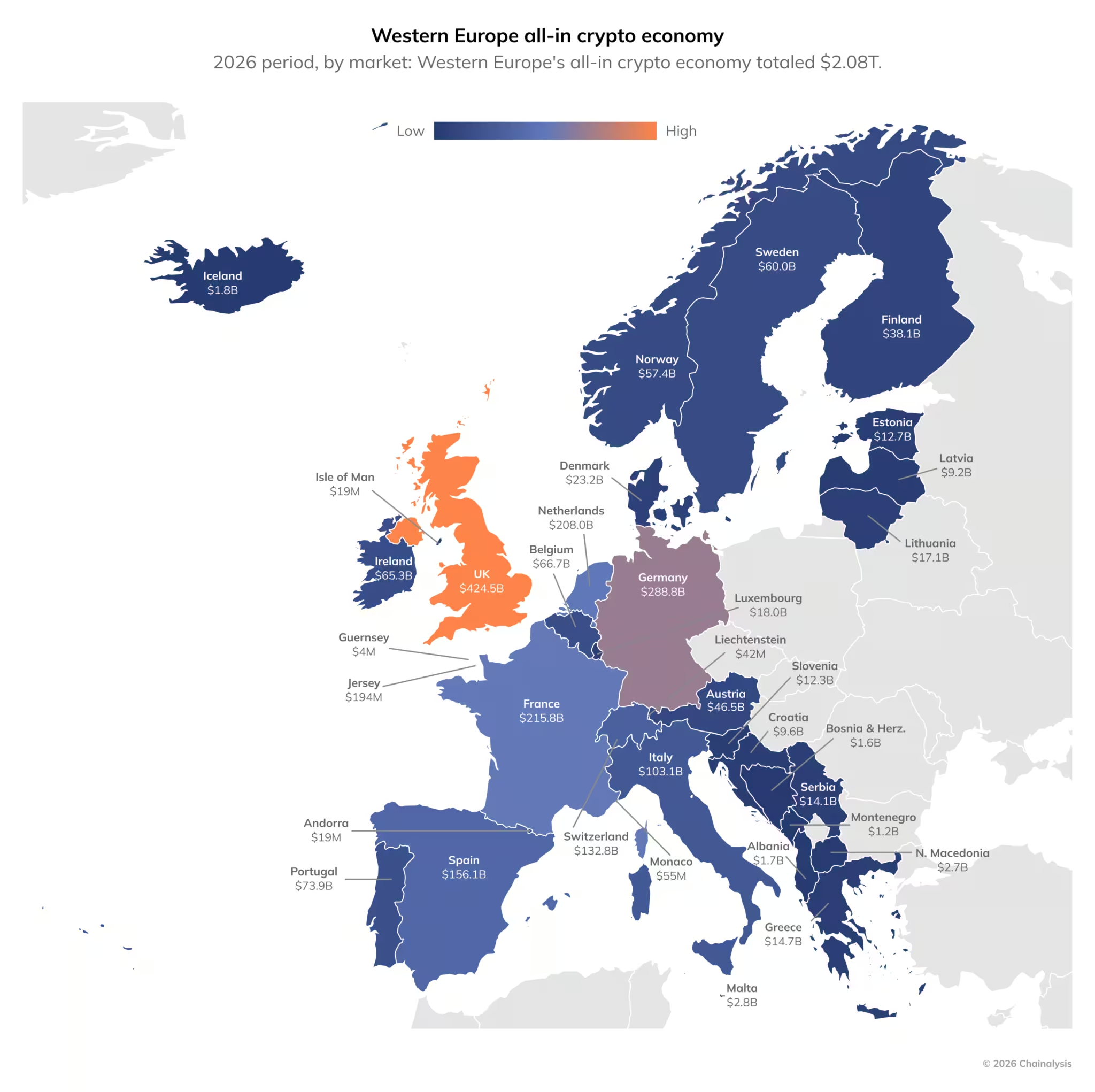
Western Europe’s crypto economy continued to expand despite a broader global market downturn, reaching $2.08 trillion in annual transaction activity as stablecoin adoption accelerated across the region.
A report published by blockchain analytics firm Chainalysis on November 9 found that crypto activity increased 1.2% between July 2025 and June 2026. This made Western Europe the world’s second-largest regional crypto economy and placed it among only three regions to record positive growth during the period.

Stablecoins were one of the strongest areas of expansion. Holdings in personal wallets across Western Europe climbed 131%, significantly outperforming the global growth rate of 52%. However, the figures also revealed contrasting trends among major markets, with the UK retaining its position as Europe’s largest crypto economy despite an annual decline in overall activity.
UK Remains Western Europe’s Largest Crypto Market Despite Contraction
The UK accounted for the largest share of Western Europe’s cryptocurrency activity, recording approximately $424.5 billion in transaction value during the reporting period. Nevertheless, activity declined 8% year over year, with reduced decentralized exchange trading contributing to the slowdown.
Germany ranked second with $288.8 billion, followed by France at $215.8 billion and the Netherlands at $207.8 billion. Spain and Switzerland recorded $156.1 billion and $132.8 billion, respectively.
Together, these six countries represented roughly two-thirds of the region’s total crypto economy, highlighting how heavily activity remains concentrated in Western Europe’s largest financial markets.
Stablecoin Holdings Outpace Global Growth
Stablecoins emerged as one of the most significant drivers of Western Europe’s crypto expansion. Personal-wallet holdings increased by 131% over the 12-month reporting period, compared with 52% growth worldwide.
The region’s share of global stablecoin balances consequently increased from 3.4% to 5.1%. Austria and France recorded particularly strong gains, while the broader trend suggests that stablecoins are becoming more important to how Europeans store and move digital assets.
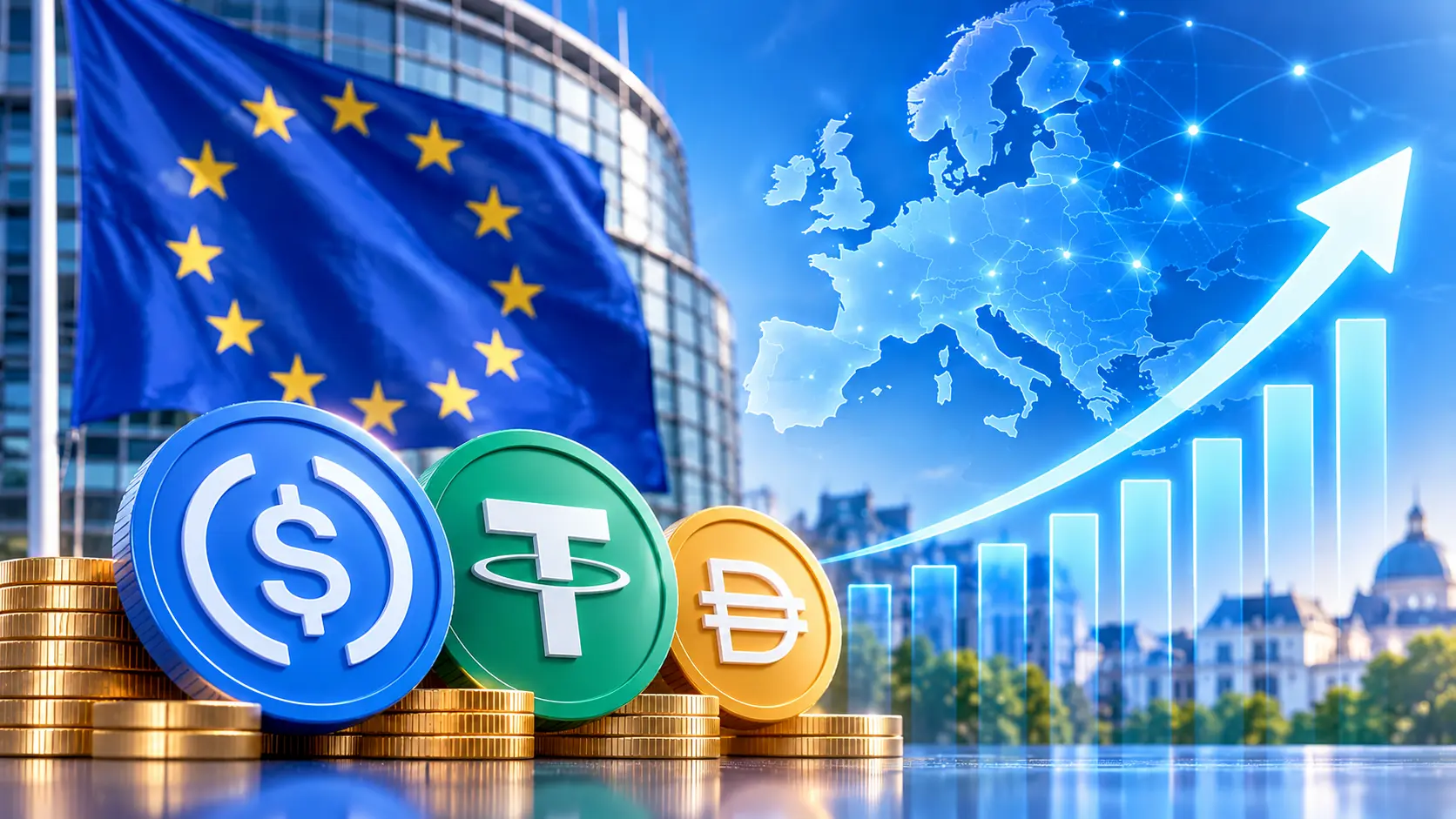
Regulatory developments are also shaping the market. The European Union’s Markets in Crypto-Assets Regulation (MiCA) has established a common framework for crypto-asset issuers and service providers, creating clearer requirements for businesses operating across the bloc.
UK Domestic Stablecoin Transfers Climb to $2.09 Billion
Despite the contraction in its overall crypto economy, the UK recorded a substantial increase in domestic stablecoin activity.
Transfers between UK-based wallets reached $2.09 billion during the reporting period, compared with just $109 million in the previous 12 months. This represented approximately 60% of Western Europe’s total domestic stablecoin transfer value, exceeding the combined $1.41 billion recorded across the rest of the region.
The findings suggest that stablecoins are increasingly being used for domestic transactions rather than exclusively for international transfers. In the UK, domestic stablecoin transfers were 1.32 times the value of the cross-border activity measured by Chainalysis. The rest of Western Europe displayed the opposite pattern, with cross-border transfers significantly outweighing domestic activity.
Retail wallet behavior also reflected growing interest in stablecoins. Approximately 1.03% of eligible UK retail wallets converted at least 80% of their cryptocurrency holdings into stablecoins, up from 0.66% a year earlier.
French Investors Increase Stablecoin Self-Custody
France recorded another notable development, with stablecoin balances held in personal wallets increasing by 192% during the reporting period.
The number of French personal wallets holding stablecoins rose from 3,577 in June 2025 to 12,255 in June 2026. Stablecoins also accounted for 54.2% of withdrawals from centralized exchanges by the end of the period, the highest proportion among the major Western European markets included in the analysis.
The trend unfolded amid fiscal pressure and political uncertainty in France. Chainalysis noted that the growth in self-custody coincided with periods of stress in the country’s bond market, although the data does not establish a direct causal relationship.
The increase suggests that more French crypto users are choosing to move stablecoins away from centralized platforms and hold them in personal wallets. This gives users greater direct control over their digital assets while reflecting a broader shift in how stablecoins are used across the region.
MiCA and Stablecoins Could Shape Europe’s Next Crypto Growth Phase
Western Europe’s $2.08 trillion crypto economy demonstrates that the region has maintained growth even as global market conditions weakened. However, the report shows that this expansion is not uniform.
The UK remains the largest market by transaction value, but its annual contraction contrasts with the growth recorded in other parts of the region. Meanwhile, stablecoin holdings, domestic transfers, and self-custody are becoming increasingly important indicators of how European users interact with digital assets.
MiCA’s regulatory framework could further influence this development by providing clearer requirements for businesses and encouraging traditional financial institutions to explore blockchain-based services. At the same time, the expansion of euro-denominated stablecoins may strengthen the connection between conventional finance and digital asset markets.
Whether these trends translate into sustained growth will depend on regulatory implementation, institutional participation, and continued demand for stablecoin-based financial services.
Do you think stablecoins will become a mainstream payment method across Western Europe as adoption continues to increase?
Could MiCA help Europe become a leading market for regulated digital assets and tokenized financial products?

Editorial Process for bitcoinist is centered on delivering thoroughly researched, accurate, and unbiased content. We uphold strict sourcing standards, and each page undergoes diligent review by our team of top technology experts and seasoned editors. This process ensures the integrity, relevance, and value of our content for our readers.