




Christine Lagarde will step down as European Central Bank president on Feb. 7, 2027, while the Eurosystem is still weighing how to organize the infrastructure for Europe’s tokenized financial markets through its Appia initiative.
The departure announcement on Oct. 29 comes a day after the Eurosystem published Appia consultation findings that expose a basic tension: concentrating settlement money on one network could make markets more efficient, but concentrating control could make them harder to enter.
Appia is the Eurosystem’s initiative to develop an integrated ecosystem for tokenized wholesale finance, where assets are issued or represented on distributed ledgers. Its new report summarizes 127 responses and leaves the architecture open ahead of a blueprint due by 2028. The findings describe stakeholder views; the Eurosystem has expressed no architecture preference in the report.
Appia’s liquidity pooling meets the access test
Settlement infrastructure determines how buyers pay for assets and how transactions are completed. Appia’s architecture question is where central bank money should be available within a market built across different distributed ledger technology, or DLT, platforms.

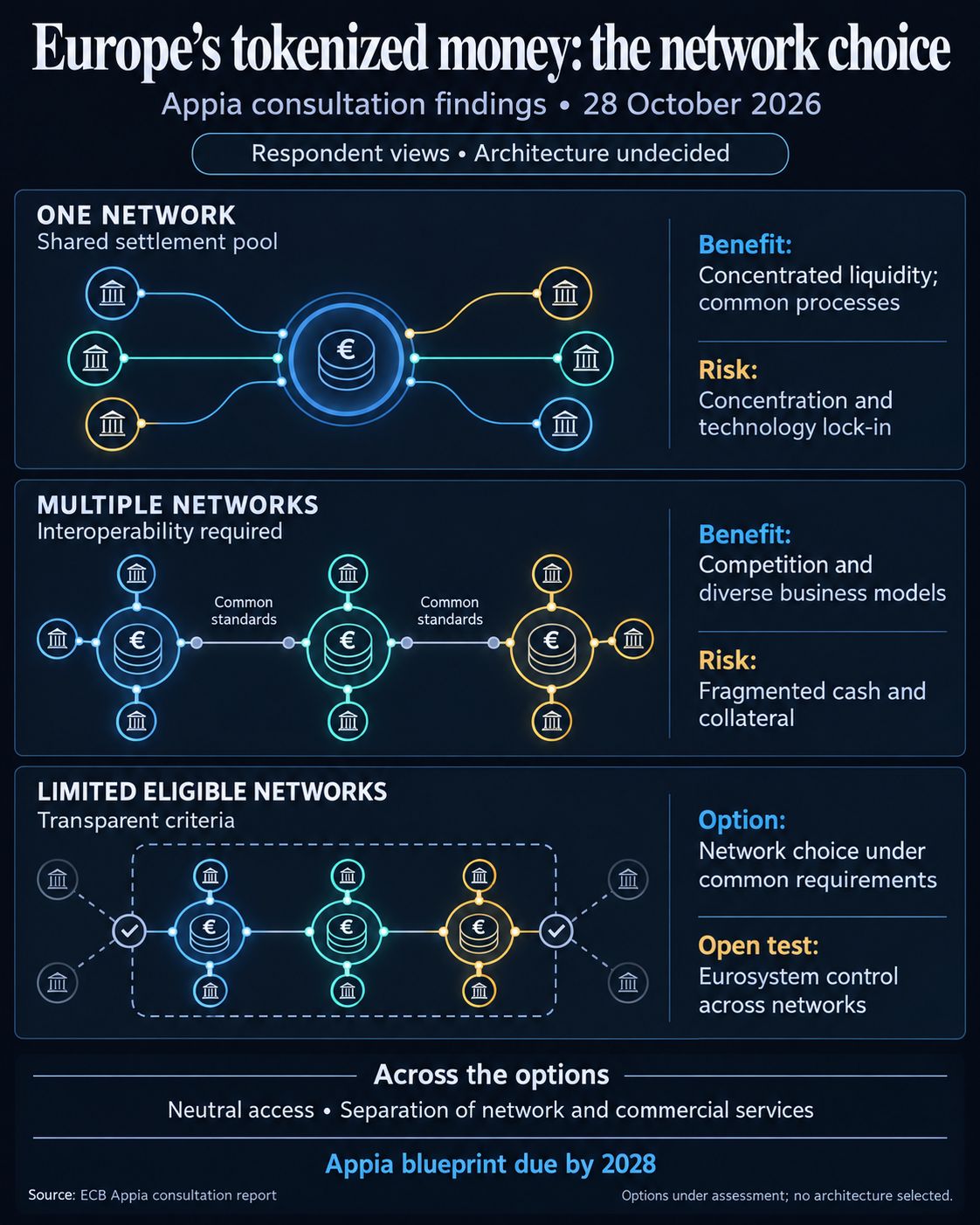
Respondents identified advantages to putting settlement on a single network. Concentrated liquidity, common processes and simpler coordination could reduce fragmentation and duplicated investment.
The same arrangement could also concentrate activity in infrastructure with systemic importance. Respondents warned about dependence on a particular technology or vendor and weaker incentives to innovate. Pooling money would therefore solve only part of the integration problem if participants became locked into the platform that held it.
Multiple networks offer a different balance. They can accommodate different business models and reduce dependence on one infrastructure. For a bank, however, competition between platforms could still leave liquidity fragmented if its money or collateral cannot move efficiently between them. Without enforceable interoperability standards, respondents warned, separate networks could divide liquidity, collateral, identity and compliance into new silos.
A third configuration would make central bank money available on a limited number of eligible networks, operating under transparent admission criteria and common standards. Many respondents proposed this configuration as a way to balance network choice with common requirements.
That option remains subject to a fundamental test. The report says the feasibility of providing central bank money settlement on more than one network, while preserving Eurosystem control over that money, still needs assessment. An eligible-network model is an option under study, rather than an announced right for operators to connect.
The consultation places access rules at the center of the competition question.
Respondents sought objective, non-discriminatory admission criteria and a clear separation between the shared network and the commercial services built on it. They generally considered client-facing issuance, trading, custody and wallets unsuitable for the shared utility, because those are activities in which providers should compete.
For a DLT operator, that distinction affects whether it supplies common infrastructure, sells services to users, or attempts to do both. The concern is that an operator competing with its own users could undermine the neutrality of the infrastructure they depend on.

The report’s account of respondent views gives greater weight to central bank control, neutrality and open access than to ownership alone. A Eurosystem-operated network and market-operated networks bring different trade-offs; either would need rules that preserve the public authority’s control over central bank money and prevent discriminatory access.
The International Capital Market Association’s April position illustrates the preference for competition at the infrastructure level. It generally favors multiple interoperable networks under harmonized standards over a single Eurosystem-operated network, citing competition, concentration risk and market-led innovation.
That submission reflects a subset of ICMA’s DLT Bonds Working Group and predates the October findings.
Banks need movable cash and collateral
For banks, the practical issue is whether settlement balances and collateral can be used efficiently across venues. A common network could concentrate those resources. A competitive network system would need reliable movement between platforms to avoid leaving usable money or assets stranded in separate pools.
The report highlights central bank involvement in liquidity routing and collateral mobilization. Those functions make interoperability an operational requirement, rather than simply an agreement that different technologies should coexist.
Euro stablecoin issuers face a related question about the role of private settlement assets. Respondents viewed tokenized deposits and euro-denominated stablecoins as potentially complementary to central bank money within a two-tier system. That creates a possible place for different payment instruments without making each instrument equivalent to central bank money.
Existing collateral policy is narrower than a general opening to on-chain assets. In his Oct. 29 speech, ECB Executive Board member Piero Cipollone said the Eurosystem has accepted marketable assets issued in central securities depositories using DLT since March 30. Whether assets outside currently eligible settlement systems can qualify, and under what criteria, remains under assessment.
Some of the infrastructure is already operating. Pontes launched on Sept. 21 with initial core services and gradual onboarding. It connects market DLT platforms with the Eurosystem’s TARGET Services so wholesale tokenized asset transactions can settle in central bank money.
Cipollone set out the next delivery targets on Oct. 29: significantly longer operating hours by mid-2027 and 24/7/365 availability in 2028. Immediate settlement finality on the Eurosystem DLT platform is planned as early as 2027.
Appia’s 2028 objective is different: a blueprint containing findings, recommendations and principles for the wider ecosystem. Cipollone also said T2S, the existing securities settlement platform, would continue alongside new tokenized infrastructures.
A leadership handover, with architecture still open
Lagarde’s successor will enter that delivery timetable without acquiring sole authority over the design. Under Article 283, the European Council appoints the ECB president by qualified majority on a Council recommendation, after consultation with the European Parliament and the ECB Governing Council. The departure release names no successor.
The Governing Council remains the ECB’s main decision-making body, bringing together the Executive Board and euro-area national central bank governors.
The next concrete signals will come from design work and the terms of market participation. The consultation report envisages more complex cross-cutting testing in 2027 and a forthcoming stakeholder call covering tokenized deposits and payments, securities and shared network governance. Participation arrangements are still to be communicated.
For banks, issuers and DLT operators, the eventual access rules will help show whether Europe’s common settlement anchor can support competing businesses without fragmenting the money and collateral they need to operate.