



Close Menu
Crypto Startup
    Instagram
    • Privacy Policy
    • Terms Of Service
    • Social Media Disclaimer
    • DMCA Compliance
    • Anti-Spam Policy
    Instagram
    Crypto StartupCrypto Startup
    • Home
    • Crypto News
      • Bitcoin
      • Ethereum
      • Altcoins
      • Blockchain
      • DeFi
    • AI News
    • Stock News
    • Learn
      • Crypto for Beginners
      • AI for Beginners
      • AI Tips
      • Make Money with AI
    • Reviews
    • Tools
      • Best AI Tools
      • Crypto Market Cap List
      • Stock Market Overview
      • Market Heatmap
    • Contact
    Crypto Startup
    Home»Crypto News»Altcoins»Eclair fee fixes target Lightning funding losses
    Eclair fee fixes target Lightning funding losses
    Altcoins

    Eclair fee fixes target Lightning funding losses

    October 12, 20263 Mins Read
    Share
    Facebook Twitter LinkedIn Pinterest Email
    kraken


    Eclair, ACINQ’s Lightning node software, has merged two repairs for gaps that could make a node lose Bitcoin through excessive mining fees during channel funding and splicing. One limits a peer’s fee-bump demands when Eclair contributes funds; the other checks transactions from a compromised Bitcoin backend while Eclair retains the signing keys.

    The repairs merged into the project’s master branch on Oct. 2 and Oct. 5. As of Oct. 12, its release page still listed September’s v0.14.3 as latest. The two October fixes postdate that packaged release.

    Bitcoin Optech’s Oct. 9 newsletter highlighted both changes as closing protection gaps during dual funding and splicing.

    Related Reading

    cryptocom

    A Bitcoin Lightning flaw could send a node’s entire balance straight to miners

    The first repair, PR #3388, concerns peer-initiated replace-by-fee, or RBF, attempts during a dual-funded channel opening or a splice that adjusts a channel’s funding. A peer could request a replacement transaction with a higher fee rate. Eclair kept its wallet contribution and paid for its inputs at that rate, without an upper bound or fee budget on this path.

    That let a malicious peer impose an arbitrary mining fee rate on the contributing node while contributing nothing itself. The loss would be paid as fees to miners rather than transferred directly to the peer.

    The repair rejects attempts above the maximum funding fee rate Eclair recommends to its peer. Two exceptions remain: the peer buys liquidity and pays the fees for Eclair’s inputs, or the Eclair node contributes no funds to the transaction. In those cases, Eclair does not bear the cost addressed by this limit.
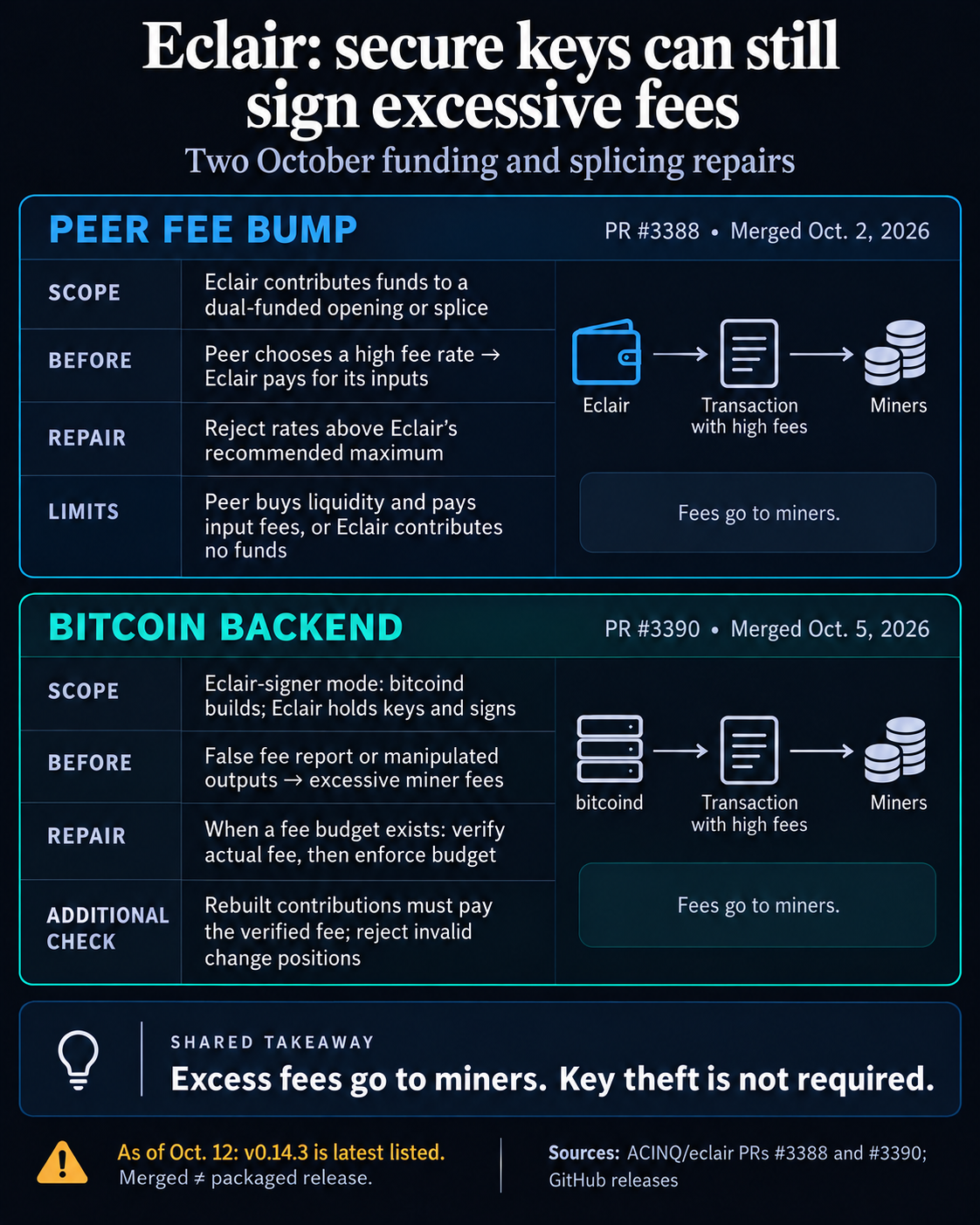
    Diagram comparing Eclair's peer fee-bump cap and Bitcoin backend fee and output checks during dual funding and splicing, with merged-versus-released status.

    Keeping keys is only part of the defense

    PR #3390 addresses a separate threat in Eclair-signer mode. Bitcoin Core’s backend, bitcoind, selects coins and builds transactions, while Eclair retains the keys and signs.

    The Catalyst

    Daily Newsletter

    Know what’s moving crypto.

    Start with the stories that matter. Get the context behind the headlines and a clear view of what to watch next.

    A compromised backend could report a fee within budget while constructing a transaction that actually paid more, including by dropping the change output. Under Bitcoin’s transaction accounting, input value not assigned to outputs becomes a miner fee. Missing change can therefore spend funds without paying an attacker’s address.

    When a fee budget is supplied, the repair calculates the actual fee from the amounts of the coins being spent, fetched by transaction ID to authenticate their values. It checks that the backend’s reported fee matches and applies the budget to the actual fee. It also checks that Eclair’s rebuilt contributions pay the same verified fee and rejects invalid change-output positions.

    Related Reading

    Lightning apps using unpatched LDK risk Bitcoin theft from a reconnect lie

    These are distinct from the cooperative-closing fee flaw covered in CryptoSlate’s September report and the restart denial-of-service issues covered Oct. 2.

    These repairs address Eclair’s dual-funding, splicing and signer configurations. Operators should check that their installed build contains the October changes.

    Related Reading

    Unpatched Eclair Bitcoin Lightning nodes could crash again every time they restart


    Source link

    coinbase
    Share. Facebook Twitter Pinterest LinkedIn Tumblr Email

    Related Posts

    Bitcoin’s Quantum Threat, Ripple Bank Approval

    November 1, 2026

    XRP: BNY JUST MADE A MASSIVE ANNOUNCEMENT! (WALL STREET IS READY!)

    November 1, 2026

    Binance Hack Rattles Crypto Markets

    October 31, 2026

    IT FINALLY HAPPENED! DTCC’S $30 TRILLION SYSTEM IS LIVE! (XRP, HBAR, XLM, CC, XDC!)

    October 31, 2026
    Add A Comment
    Leave A Reply Cancel Reply

    kraken
    Latest Posts

    Laziest Way to Make Money With AI (Copy This)

    November 2, 2026

    The 4 Claude Features That Will Put You Ahead of 99% of People Using AI

    November 2, 2026

    The AI Hacks Have Begun. What Happens Next?

    November 2, 2026

    Bitcoin ETF Outflows Hit $643M, but BlackRock Bucks Trend

    November 2, 2026

    Bitcoin’s Quantum Threat, Ripple Bank Approval

    November 1, 2026
    tradingview
    LEGAL INFORMATION
    • Privacy Policy
    • Terms Of Service
    • Social Media Disclaimer
    • DMCA Compliance
    • Anti-Spam Policy
    Top Insights

    Ethereum Price Prediction: Will ETH Crash Below $2,250 as Funding Rates Sink?

    November 2, 2026

    If Rates Go Up, Are Canadian Bank Stocks Buys or Traps?

    November 2, 2026
    kraken
    Instagram
    © 2026 CryptoStartup.news - All rights reserved.

    Type above and press Enter to search. Press Esc to cancel.