



“Our mission is to convert waste plastic pollution into durable composites to build 1 billion homes,” says Atlas chair and co-founder A.J. Perez ’13, MNG ’14, PhD ’23, who is also an MIT research scientist. “You can’t divorce these things from each other. We’re not here just to build homes, and we’re not here just to recycle plastic. The conventional way of building homes involves cutting down trees, mining, refining, and a bunch of other dirty activities. We want to avoid all that and address all the plastic bound for our oceans and landfills. We’re turning bottles into buildings.”
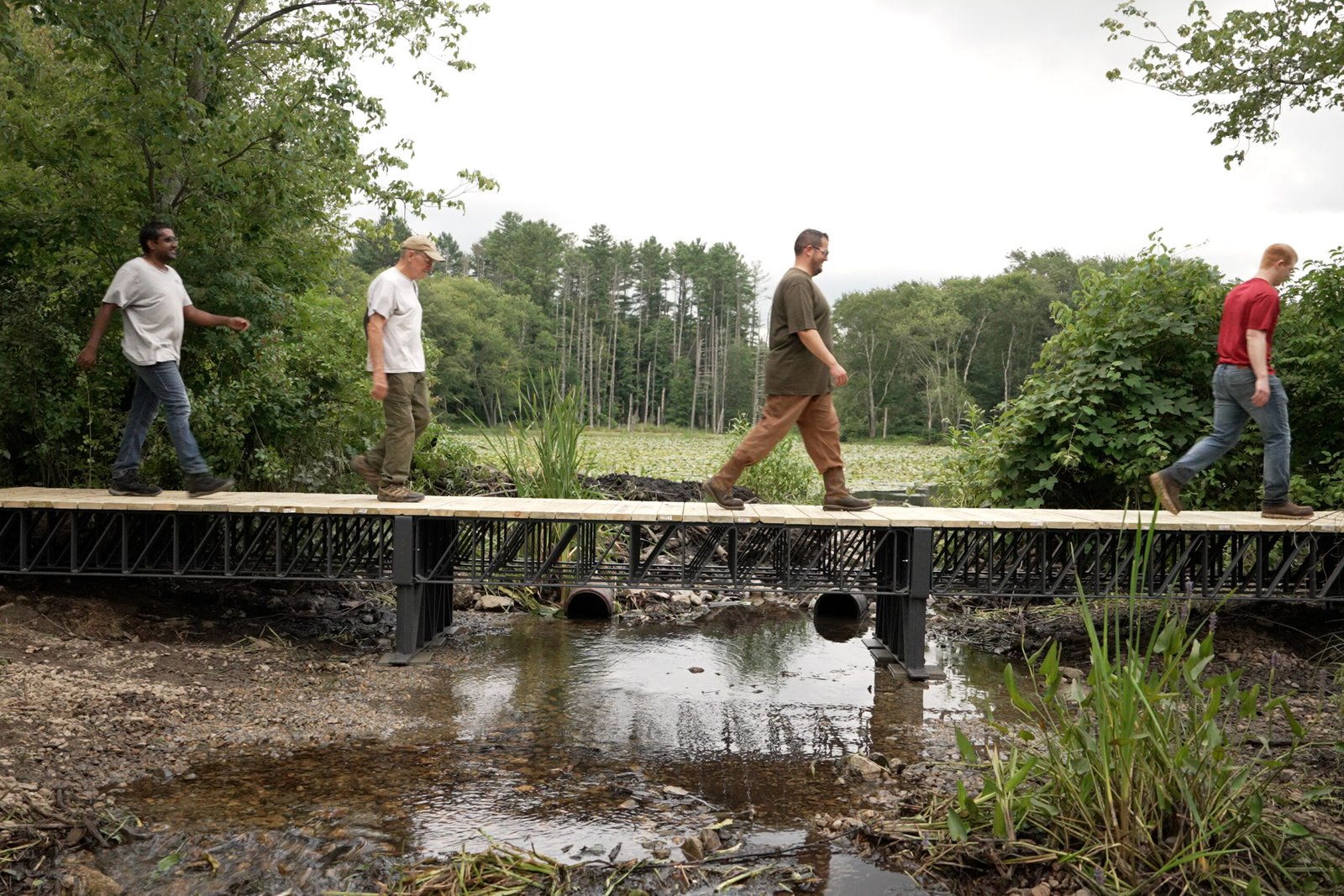
Atlas’ parts are already being used to support barns, sheds, decks, and docks. Most recently, the company supplied the U.S. Army Corps of Engineers with American-made recycled composite trusses to construct a 40-foot bridge in a Massachusetts wetland.
Perez and Atlas co-founder Matt Pouliot envision deploying thousands of their AI robotic production systems around the world. A key enabler for that scale is the company’s ability to recycle low-grade plastic into building components without water.
“This is key to democratizing recycling,” Perez says. “Now, every country around the world, regardless of their water access, will be able to do something about their plastic. We strive to study these issues in the real world, not just a lab. When you talk to government officials about creating a new recycling facility, they have to get the local water agency involved, there’s permitting, etc. A lot of that work disappears with the waterless recycling process.”

Research for impact
Since earning his PhD at MIT, Perez has been developing advanced fabrication techniques for homes and new techniques for plastic recycling. In 2019, he started MIT HAUS with David Hardt, MIT’s Ralph E. and Eloise F. Cross Professor in Manufacturing.
“It started with the simple mission of enabling the production of 1 billion homes over a 30-year period,” Perez says. “Then we realized how much the materials needed for those homes would strain global supply chains.”
Perez says building those homes using conventional methods would require a doubling of global production capacity for materials like concrete, not to mention a dramatic acceleration of global deforestation.
“That’s where the light bulb went off,” Perez says. “There’s this other problem humanity has, which is 8 gigatons of plastic that have been produced and are polluting our oceans, rivers, and cities. We decided to plug two really big, hairy problems together.”
Perez met Pouliot, a former Maine senator, and the pair started Atlas to commercialize the technology Perez had been developing at MIT. The founders worked with MIT’s Technology Licensing Office and have since worked with researchers at other universities to independently develop technology for the company’s robotic manufacturing platform, which the founders call the Atlas Factory Stack.
First, single-use plastic from water bottles and other objects is shredded and fed into the Atlas system, where it is melted and fused with American-made fiberglass to make it stronger than wood. From there, a large-scale 3D printer creates the parts, including trusses for floors, walls, roofs, and bridges.
Through research at MIT, Perez has shown large composite trusses can be printed in under 13 minutes and support over 4,000 pounds, exceeding key building standards.